
WillAITake Your Job?
Find out which parts of your job AI will automate first —
and exactly what to do about it.
The professionals who know their risk are already upskilling. The ones who don't are falling behind.





Get your full report by email. Takes 2 minutes. Join 47,000+ professionals who know where they stand.
The rules of work
have changed forever.
In just three years, AI has gone from a curiosity to a co-worker. It writes code, drafts reports, analyses data, and handles tasks that used to take humans hours — in seconds.
This isn't a distant threat. Goldman Sachs estimates 300 million jobs face exposure. The WEF reports 44% of core skills will be disrupted by 2030. The question is no longer ifAI will affect your career — it's how much, and how fast.
Knowing where you stand is the first step to staying ahead.
“By 2030, 44% of workers’ core skills will be obsolete.”
— World Economic Forum, Future of Jobs Report 2025
Is yours one of them?
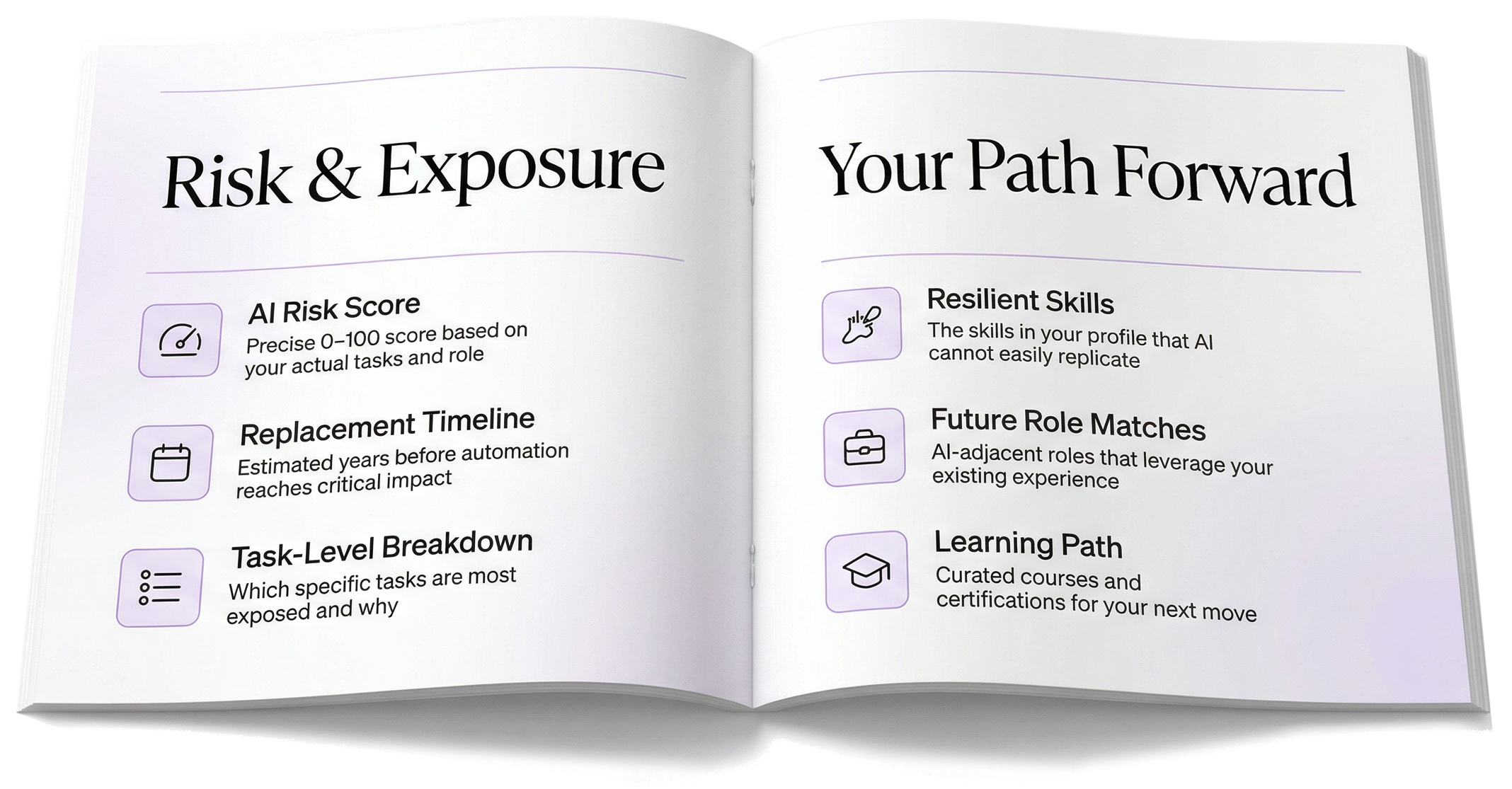
Four things your report tells you
Your AI Risk Score
A precise 0–100% score specific to your job title, years of experience, and industry — not a generic bucket.
Your Automation Timeline
When the biggest changes hit your role: near-term disruption, acceleration phase, and high-impact window.
Which Tasks Are Safe
A task-by-task breakdown showing exactly which parts of your job are already being replaced — and which are resilient.
Your Action Plan
Specific skills to build, roles to pivot toward, and certifications that give you the biggest advantage — tailored to your profile.
The AI displacement wave
is already here
Three data points that reframe the conversation — backed by peer-reviewed research.
Goldman Sachs, 2023
WEF Future of Jobs, 2025
McKinsey Global Institute, 2023
From job title to full risk report in 2 minutes
Enter Your Role
Tell us your job title, industry, years of experience, and work type — takes under 2 minutes.
AI Task Analysis
We match your role to O*NET task data and score each task against current AI automation capabilities.
Risk Scoring
Your weighted AI Risk Score is calculated using models from McKinsey, WEF, Oxford, and Stanford research.
Your Report
Receive a personalised report with your score, timeline, resilient skills, and recommended next steps.
Built on peer-reviewed data

¹ O*NET OnLine, U.S. Dept. of Labor — occupational task database
² McKinsey Global Institute, The Future of Work after COVID-19, 2021 & A New Future of Work, 2023
³ World Economic Forum, Future of Jobs Report, 2025
⁴ Stanford HAI, AI Index Annual Report, 2024
⁵ Frey & Osborne, The Future of Employment, Oxford, 2013
⁶ MIT Work of the Future Task Force, Shaping the Future of Work, 2023
Here's what your report looks like
Real output based on O*NET task data and AI research. Pick your profession:
Why this score?
Mortgage loan officers face severe displacement pressure as AI now handles document ingestion, credit scoring, income verification, and rate comparison in seconds. Platforms like Blend, Roostify, and Rocket's AI underwriting engine already process 70–80% of standard loan applications end-to-end — with no human in the loop until final sign-off.
Task Exposure
Tap a task to see why — and what you can do.
What happens over the next 3 years
Your Path Forward
Own the human layer that AI can't replace — complex client cases, edge scenarios, and the relationship trust that closes deals. Your domain depth becomes your moat.
- AI underwriting tools (Blend, Roostify)
- Complex loan structuring
- AI-augmented client advisory
- Fannie Mae Collateral Underwriter
- MBA AI in Mortgage Certificate
Help lenders implement AI platforms. Your insider knowledge of loan workflows is worth more to fintech vendors than any engineer who's never closed a loan.
- LOS platform consulting (Encompass, ICE)
- AI adoption change management
- Lending process analysis & optimization
- ICE Mortgage Technology Certification
- PMP (Project Management Professional)
Pivot to holistic financial planning — a relationship-first role where empathy and trust are structural advantages that no model can replicate.
- Holistic financial planning
- Retirement & investment planning basics
- Client relationship management
- CFP (Certified Financial Planner)
- FINRA Series 65
Professionals who know where they stand
“I'm a data analyst. Seeing 83% hit different. I've already signed up for two ML courses and started building side projects. This was the wake-up call I needed.”
“Shared this with my entire team after our quarterly planning. Everyone needs to see where they actually stand — not where they hope they stand.”
“Finally something that doesn't just scare you — it tells you exactly what to do about it. The pivot roles section alone was worth it.”
Latest from the research desk
Which Jobs Will AI Replace First?
New WEF data reveals the occupations facing the highest near-term disruption risk.
5 min read →5 Skills That Make You AI-Proof
The human capabilities that research consistently shows AI cannot replicate effectively.
7 min read →How Accountants Are Pivoting to AI
Real stories of professionals who transformed threat into opportunity with targeted upskilling.
6 min read →The Automation Timeline: 2024–2030
A data-driven forecast of which sectors will see the most AI-driven workforce change by 2030.
8 min read →Your Action Plan: From Risk to Resilience
A step-by-step framework for professionals who want to stay ahead of AI disruption.
4 min read →